Search This Blog

Showing posts with label Jennifer Lawrence. Show all posts

Monday, March 5, 2018

Backstage at the Oscars: 2018

Okay, so where am I? 

I've been a little fidgety because the Oscars seem so late this year. I mean I can't recall the last time the show was as late at March 4th. But today is where my dreams soar while I settle into my spot on the red carpet (which as you all should know is actually a burgundy shade of red) of the Academy Awards®. I mean, I only have three scripts written (two for film and two for television), but I sincerely believe that somehow one of these will become the perfect blend of compelling, emotional, heartfelt, and ultimately Oscar-worthy. Let it be noted that I don't want to be like that dude Terry Bryant who tried to steal Frances McDormand's statuette at the Governor's Ball. I want to earn my own.

I hope more watch the telecast though. This year the show lasted nearly four hours and tumbled 19 percent from 2017 with only 26.5 million viewers. That's easily the least-watched Oscars in history, trailing 2008 by more than 5 million. Yikes!

This still a far better audience than I received from my agent. I've been waiting for his promises to be fulfilled since we talked about traveling to Beirut together in 2006. Alas, I'm going it on my own and every year I feel like I'm being chased by the Revenant bear. I was told once that you have to persevere to success.

Here's to perseverance...

So for the seventh straight year, and without further ado, here's my take on the happenings backstage at the 90th Academy Awards:

BACKSTAGE INTERVIEW WITH:
Frances McDormand, Three Billboards Outside Ebbing, Missouri
Performance by an Actress in a Leading Role

A. Thank you. Don't give me anymore attention because it will all go to my head. Come on. Ask away. I'm ready. I'm ready.

Q. Please explain your comment at the end, the two words "inclusion rider."

credit: Michael Yada / A.M.P.A.S.
A. Right. I just found out about this last week. There is -- has always been available to all everybody that get -- that does a negotiation on a film, an inclusion rider which means that you can ask for and/or demand at least 50 percent diversity in not only the casting, but also the crew. And so, the fact that we -- that I just learned that after 35 years of being in the film business, it's not -- we're not going back. So the whole idea of women trending, no. No trending. African Americans trending, no. No trending. It changes now, and I think the inclusion rider will have something to do with that. Right? Power in rules.

Q. I want to ask you about a bit of a follow up to that question. The tone of the evening, obviously it's about awards, but there was certainly throughout the evening the idea that this was a different Oscars than in the past because of what has happened since October.

A. No. It actually was it happened way before that. I think that what happened last year, you know, with Moonlight winning the best picture, that's when it changed. And it had to be acknowledged. That had to be acknowledged, and it was acknowledged in the best possible way. Not just by, you know, fixing the mistake, but actually recognizing that that won Best Picture. Moonlight won Best Picture of 2017.

Q. It was about the idea that this evening was sending a message because of the activities that have happened and the revelations and women being brave enough to speak out since October. Did you feel that was handled properly and enough this evening?

A. Well, yeah. You know, it was really interesting because like I said, feeling like I was Chloe Kim doing back to back 1080s in the halfpipe, I was -- I don't do everything. As you know, I don't show up all the time. I only show up when I can and when I want to, but I was there at the Golden Globes and it's almost like there was an arc that started there. It doesn't end here. But I think publicly as a commercial, because that's what we are ‑‑ this is not ‑‑ this is not a novel.. This is a TV show after all, but I think that the message that we're getting to send to the public is that we're going to be one of the small industries that try to make a difference. And I think $21 million in the legal defense fund is a great way to start. And the commission that's being headed by Anita Hill, that's really smart. See, we didn't just -- we didn't just put out commercials about it. We actually started a conversation that will change something.

Q. Okay. Three Billboards has started a movement. Have you seen the billboards all over the world?

A. Oh, are you kidding? Off the screen and on to the street. Really exciting.

Q. Talk about that. I want to hear what your comment is about that.

A. Well, you know, recently my husband and I were in London at the BAFTAs, and we went to the Tate Modern and we saw an exhibition about the Russian Revolution -- Russian Revolution and the propaganda that was used. Now, that revolution did not go so well, so we don't want to think too much about that. But the red and black is a really, really good choice. And Martin McDonagh knew that. He was involved in the choice with the with the set design of the film to use that kind of iconography, and I think that idea that activists are taking that kind of statement and putting it out there billboards still work. They still work. So I think that it's really exciting. It started actually with the Grenfell Tower fires investigation. Then it leapfrogged to the Miami gun control situation. It was outside the UN about the Syrian situation. You know, it's a kind of -- that's the kind of power that an image can have. And that's what we're making. We're making powerful images.

BACKSTAGE INTERVIEW WITH:
Gary Oldman, Darkest Hour
Performance by an Actor in a Leading Role

Q. You asked Kazu makeup artist to work with and why do you think he's special? Computer graphic can't replace his work.

A. Do I think the computer graphic can replace his work?

Q. Yeah.

credit: Michael Yada / A.M.P.A.S.
A. I hope not. You know, the ‑‑ the clothes, makeup and clothes are the things that ‑‑ are the closest things to the actor. And they actually touch the actor.  And they are the first people that you meet in the morning and they are really ‑‑ they are vital individuals that you interact with to ‑‑ I've done motion capture and you are in a gray void with no costume, and they then CG it on you later.  So to lose that kind of connection, you know, we really ‑‑ we worked as a team. And plus, it's always easier, I think, to throw something out because something new comes along. You know, just because you can.   mean, he's a consummate artist and it was really my ‑‑ once I had stepped off the ledge, as it were, with Joe Wright, I said to Joe, it's contingent on getting Kazuhiro because, for me, he was really the only person on the planet that could have ‑‑ that could have pulled it off. I mean, I think he delivered.  Yeah.

Q. It's been almost a year since we were in Vegas, and you said if you ‑‑ if they will offer the Oscar, you wouldn't say no.  So what it really means to finally get it?

A. I didn't say no.

Q. What it means, what it means for you an Oscar, to win an Oscar?

A. I think for this role, it's got a sort of special -- it feels like it has a special significance. I can't say what it would be like to win an Oscar in any other year. But winning an Oscar for playing arguably one of the greatest Britons who ever lived. To win it for playing Winston makes it doubly special. Does that make sense? And this film and this company of actors and Joe, working again with Sarah Greenwood and Jacquie Durran and those actors on the set, it was a very -- it's been an unforgettable experience and a highlight of my career.

Q. What is it like for you meeting so many young actors and young filmmakers that have looked up to you in their youth and throughout their career and are getting to share the stage with you tonight?

A. I think we are -- the thing that I -- one of the lessons that I learned from -- from John Hurt, the late John Hurt, God bless him. When I was a younger man, went to the cinema, I looked up at, you know, Albert Finney and Tom Courtenay and Alan Bates and Peter O'Toole, and Alec Guinness, Peter Sellers, they were all sort of my heroes. We are links in a chain, you know. I'm thrilled for Chalamet. He's a lovely kid. I mean, he really is. He's a kid. And he's a charmer. Hugely talented. And I said to him tonight, in the words of Armie, You will be back. You know, he's got -- this is probably it for me. He's got years. He's got years yet.

Q. This movie seems to be a lot about facing up to great fears and great obstacles. Do you think people can relate to that in their lives apart from, like, politics and stuff like on a personal level so they connect to it in the movie?

A. We all have -- I think we can all relate to -- I mean, Joe has said that there's part of the movie that is about doubt. But those insecurities and fears, we do things -- we want to do things with the best intentions. I would like to give people the benefit of the doubt and say that they are motivated by a good heart, and, you know, they have the best intentions. You know, but when you are in a position like, I think, Winston is in like he was in 1940, we see in the movie he sends 4,000 men to their death to save 300,000. And when you are in that big chair, making those decisions, though in war, those are the types of things -- those are the types of decisions that you have to make, and then of course I don't know how you then sleep soundly in your bed on the evening of the day when you sent 4,000 innocent men to their death. But you walk -- you walk in those shoes. And I think that we can all    we -- not that extent, but, you know, most people, I think, you know, in the audience, they have got financial worries. They have got children. They are trying to put the kids through college or they have illness or sickness in their family. We've all got -- and certainly, I know that I, you know, there are regrets and things. And you -- you know, that's the worst thing you can do as an artist is you can edit yourself and second guess, but I still sometimes have that little demon on my -- that little voice talking to me like that kid, you know, Mrs. Torrance.

Q. If Winston Churchill were alive today, what advice would you think he would give the leaders of the world?

A. Oh, my heavens. He would probably 

Q. Impeach Trump?

A. He would what?

Q. Impeach Trump?

A. Maybe. My God, he would give him a good talking to, wouldn't he?

Q. What would he say?

A. Well, none of them look at history. He was a big believer that you've learned -- that you've looked at history to move forward. There's an -- actually, there's an interesting thing. There was sort of a survey done, and the children were asked about Winston Churchill, and not just -- I'm not talking about nine or ten year olds, I'm talking about, you know, young, young sort of college people. And a great many of them thought that he was either a soldier in the First World War or he was a dog in a TV commercial in Britain, and there is a TV commercial called Churchill, and it's a bulldog, and he talks. It's an insurance company called Churchill. And we don't -- we don't teach history anymore, do we? They don't know anything about it.

BACKSTAGE INTERVIEW WITH:
Sam Rockwell, Three Billboards Outside Ebbing, Missouri
Performance by an Actor in a Supporting Role

Q. Could you tell us more about the process? How you embodied the character? How you started working on that role?

credit: Michael Baker / A.M.P.A.S.
A. Oh, it's so boring, but if you want to hear it, I can tell you the whole -- you know, it's like a big soufflé or a stew. You throw in some potatoes and some carrots in there and you work with an amazing dialect coach like Liz Himelstein who worked with Gary Oldman and Margot and Terry Knickerbocker, my acting coach. And I did some ride alongs with some cops, Josh McMullin in Southern Missouri. Liz Himelstein taped two cops, actually. There was a guy named Demer [phonetic] in L.A. I did a ride along with him. And I met with this skin graft doctor who introduced me to some burn victims, actually. I mean, but the thing is, that's if you have luxury, the luxury of time, you know, which you don't always have for a part. And then I worked with Martin and but sometimes you get a part and you only have a week or a couple days to prepare. I heard that Jeremy Renner only had four days to prepare to play Jeffrey Dahmer, which is a lot, if you are playing Jeffrey Dahmer, you know. So I had the advantage that I had, like, two or three months. And so I got to indulge in all this research. And so it was a lot of fun. So that's the long answer to your short question.

Q. You said a wonderful thing about the arc of your character being Barney Fife going into Travis Bickle.

A. Yes, yes.

Q. I'd love to ask, in any way, was Barney Fife and the great Don Knotts any inspiration to you as an actor throughout your career?

A. Absolutely. I mean that when I say Barney Fife and, you know, the town of Ebbing is very much like Mayberry, and Woody Harrelson's character is very much like the Andy Griffith character. And, in fact, I could be wrong about this, check your facts, but I think we shot in Sylva, North Carolina and I think Mayberry was shot there, but I could be wrong about that. But, you know, the goofiness of Barney Fife, the kind of hapless thing of Barney Fife, and then his transition into somebody else was just sort of -- Travis Bickle was kind of a -- Barney Fife to Travis Bickle was kind of a generalization, but it's a lot more complicated than that, obviously, but, you know, yeah.

Q. You dedicated your win to Phil Hoffman. 

A. Oh, you caught that, good.

Q. So I'm curious, as a friend and as a colleague, tell me, you know, what he meant to you, how he inspired you.

A. Well, I guess you want to start making me cry, but he's, yeah, he was an old friend of mine, and he directed me in a play at the Public Theater and, yeah, he was very close to me and he was an inspiration to all of my peers. You know, people like Jeffrey Wright, Billy Crudup, Liev Schreiber, you know, you know, everybody. Mark Ruffalo, Josh Brolin. I mean, whoever was in my age range, Phil Hoffman was the guy. And he was a great director and he believed in doing theater. In fact, he was -- he vowed to do a play a year, which I don't know if he got to do because he was very busy doing movies, but he was a great inspiration and a great theater director. And I don't know if anybody knows, he was a bit of a jock. He was a wrestler, and he played basketball, and he inspired me. And I could go on for an hour about Phil Hoffman. Philip Seymour Hoffman was a good friend and he was a huge, huge inspiration on me. Yeah.

Q. I stopped counting at 21 the awards that you won. So do you count them at all and do you feel that those were like billboards saying, Sam, you're going to win the Oscars now?

A. No, but that sounds like a really cool dream, but no, no.

Q. Can you talk about, specifically, your character and whether you take that criticism on or was that how you dealt with it and your sense of that?

A. Well, yeah. I mean, it's a complicated issue, but, I mean, Kareem Abdul Jabbar wrote an article that was really amazing sort of defending the movie as far as that goes and it was really eloquent. I didn't realize he's like a cultural professor, which I didn't know, in addition to being like a basketball icon, and that was a great article that articulated everything. And I think for me, you know, the whole thing is that, you know, they have a lot of work to do, Mildred and Dixon. It's not like they are like all of a sudden redeemed at the end of the movie. They have, you know, a lot of work to do and maybe some therapy, you know. It's an ongoing thing, you know. So, and it's also it's a movie and it's a dark fairytale of some sorts. And so it's like, it's not necessarily -- in real life we probably would have gone to prison, both of our characters, so, you know. That's -- that's sort of how I see it.

BACKSTAGE INTERVIEW WITH:
Allison Janney, I, Tonya
Performance by an Actress in a Supporting Role

Q. So winning an Oscar by yourself with no one's help, that's an awesome feat. So now that you've won this big honor on your own, how are you going to change on a day-to-day basis?

A. I have to be at a table read for Mom at 10:00 a.m. tomorrow morning. So I am going right back to work, and I will ‑‑ I am so happy that I have a job to go to after something like this.  Because it could go to your head, and then tomorrow to wake up and feel ‑‑ and have nothing to do and have this whole journey be over. Starting in September when we premiered at the Toronto Film Festival, and the whole journey we've been through is extraordinary. And it's going to be ‑‑ I'm going to have a big crash down after this.  So I'm happy that I have Mom ‑‑ the people at MOM to lift me up and keep me ‑‑ keep me going and keep me focused. And I'm just happy to have a job to go to tomorrow. But this is extraordinary. Thank you.

credit: Michael Yada / A.M.P.A.S.
Q. Hi.  So where did trophies ‑‑ I mean, you have a ton of Emmys. You've got every award leading up to this one this year. Now you have an Oscar. Was that ever part of your fantasy of what your acting career was going to be like? Or is this like this great side effect?

A. I certainly ‑‑ I kind of didn't dare to dream of things like this, because I didn't want to be disappointed. And I think at a certain point, I had given up thinking this would happen for me because I just wasn't getting the kind of roles in film that would give me attention like this, and that's what my very good friend Steven Rogers did for me. He says he did it ‑‑ wrote this for me to do just that, to show a different side of me and show that I could ‑‑ what I could do, and I will never be able to repay him. It's an extraordinary gift he gave me. It's kind of overwhelming.  I think I'm going to get him a Rolex. I don't know. What do you think? And engrave it on the back. I haven't figured out what, but I've got to get him a good present. That's a start at least.

Q. You've spoken about using your inner critic. But what is your inner voice saying right now?

A. "Bravo.  Good going, girl.  I'm proud of you."

Q. We're asking what makes a great story?

A. Oh, God. What makes a great story?  Fully realized characters, characters with ‑‑ who have big needs, wants, desires that butt up against people who don't want them to have them.  Definitely great characters and great writing.  Great writing is key. That's why I'm ‑‑ when I read a script as an actress that I get excited about like I, Tonya, American Beauty or Juno, things that ‑‑ or West Wing I've gotten to do. That just gets me so ‑‑ it makes me want to come alive, and I feel like I come alive when I do all different roles I've gotten to do.  And it's how I feel the most tethered to the earth, and I feel a communicator when I'm sit‑ ‑‑ telling others' stories. And great storytellers are great writers, and I like telling ‑‑ I like telling stories.

Q. Can you talk us through a little bit of what it was like working with Margot Robbie and director Craig Gillespie?

A. Craig Gillespie?  Yeah. I met them both ‑‑ well, I met Margot the day before I started shooting, and I really ‑‑ I only had eight days to shoot this role with them because I was doing Mom, and I was rehearsing for Six Degrees of Separation, the Broadway play I did last spring.  I've never been more busy as I was last year, so when this came together, I had no time to do it, and all of the producers made it happen, the producers of Mom and Six Degrees and Margot and Tom and Bryan, Bryan Unkeless and Tom Ackerley of LuckyChap.  They made it happen for me, and they're extraordinary.

Margot has ‑‑ she's kind of a phenomenon. Because I have no head for business whatsoever. All I know how to do was be emote [sic] and do my act. But she's got this great head for business and a beautiful heart and an artist's soul and a heart. And she's remarkable, and I cannot wait to see what she's going to accomplish in her career. She's, you know, 20‑nothing, and she's done this unbelievable performance in I, Tonya, and she's going to do extraordinary things. They're both ‑‑ and Craig's just ‑‑ he killed this movie. He just killed it.  And I mean killed in a good way. He just nailed it. He knew how to ‑‑ he knew how to get just ‑‑ was a running freight train. We had no time to shoot it, and he had the best sense of humor and best attitude, and knew how to grab things on the fly. And he's just ‑‑ remarkable man. They're both ‑‑ I've never even been to Australia, but I've got to go now.  Because, I ‑‑ yeah.

ACCEPTANCE SPEECH:
Guillermo del Toro, The Shape of Water
Best Picture and Directing

Q. At the Golden Globes I asked you about how you balance the light and darkness and you said, "I met somebody."

A. Yes.

credit: Michael Baker / A.M.P.A.S.
Q. And you created a meme that's gone all around the world and affected millions of people. So the question is how do we keep that ‑‑ how do we help you keep that going? How do we stop the scapegoating of Mexico and really reaffirm your unique and magnificent culture?

A. I think every time we can demonstrate in any forum, be it sports, science, art, culture, anywhere, what we have to bring to the world discourse, to the world conversation, is extremely important, and it's extremely important when we do it to remember where we're from, because it's honoring your roots, honoring your country. Now I'm going ‑‑ my next stop is I'm going to see my mom and my dad this week.  I'm going back home with these two ‑‑ with these two babies.

Q. Congratulations. You spoke fondly about Fox Searchlight on stage, and I wonder if you know anything about the studio's future? Have you talked to anybody at Disney about it? Have they reached out to you? What can you say about that?

A. As they say here, it's above my pay rate. Way above my pay rate. But what I know is I'm continuing conversations with them about future projects, you know, and you form bonds with a studio, but you form bonds with individuals, with people that support you. And whatever that I ask for, it goes or stays, you continue creating.

Q. How is this a victory for Hollywood North and the production going on in Canada?  So much of this was done in Toronto.

A. What I will say when we started this, Miles [J. Miles Dale] and I, we talked very, very seriously about creating this movie with heads of departments from Canada. We wanted to ‑‑ you know, I've been there working for more than half a decade continuously, and I wanted to ‑‑ we wanted to show the talent and showcase the talent of the HODs in Canada and make it something where you don't go and use a rebate and escape. You know, you go to use the talent, you go to have the artistry, you go to have the complicit creation with everybody there.

Q. Before the movie was released, you said that you didn't dare to dream about the Oscar, but if you had the chance you wouldn't dare to write a speech and prepare that.  So my question is: Did you do it? Did you write it? Did you think about doing it? And what did you have left to say?

A. The only time I wrote a speech was on the beginning, and I pulled out the paper and I couldn't read it and, you know, I was sweating into my eyes, and I started just speaking from the heart. So, what I wanted to do ‑‑ what I did here is the same.  I thought, you know, I'm going to get there, and if I have a little piece of paper and I count down, it's horrible because you see the numbers.  So just talk about what you're feeling at that moment.

Q. I'm wondering why it is ‑‑ why did you choose Baltimore?

A. You know, I fell in love ‑‑ when I was a kid I fell in love with one of the primal trilogies in cinema for me, Barry Levinson's Baltimore trilogy, you know, and I loved the setting. And I know we screwed up with the accent.  I'm very, very, very aware with that, but what I wanted was to capture that flavor.  You know, it's such an interesting mixture, the Catholic, the industrial, how near is to the ocean, all those things, and for me it was mythical.  Levinson invented so many things in those films, and particularly important for The Shape of Water was the Tin Men and the Cadillacs in Tin Men and how they represent America, and that isn't there.  You know, I think that those three films, Avalon, Diner and Tin Men are fabulous landmarks of American cinema. And then the John Waters, man.

NOTES ON THE SCORECARD:

Past Media Guy Oscars Backstage Columns: 20172016 - 2015 - 2014 - 2013 - 2012

The Big Four -- Oscar-winners Sam Rockwell, Frances McDormand, Allison Janney and Gary Oldman pose backstage with their Oscar for Achievement in acting:

credit: Michael Yada / A.M.P.A.S.
Emma Stone checking out her phone, or lines, or her massive bank account:


The rare double: Kobe Bryant (with director Glen Keane) now has an Academy Award and an NBA MVP for Dear Basketball as Best Animated Short Film:

credit: Matt Sayles / A.M.P.A.S.
Jordan Peele and Nicole Kidman share a winners' chat backstage:


There was extra attention on the Envelopes this year:


Helen Mirren -- in her fourth dress -- falls in love with Uncle Oscar all over again:


Finally, my favorites from the red carpet:

The installation..


JLaw, I can't quit you...


Daniel Kaluuya staying Get Out character the entire time...


As I did in 2017, I sneaked across the red carpet to the Oscars' step and repeat… What a rush… I feel like I robbed a bank, again!:


Allison Williams being interviews with cue cards behind her...


Jordan Peele's smile...


Emma Stone's Laugh...


Armie Hammer going out of his way to prove he was acting in Call Me By Your Name during the entire red carpet experience...


Margot Robbie's Greetings...


The happiest couple I saw -- Sam Rockwell and Leslie Bibb...


With these captures from a special night, I hope to see you for my eighth straight year with an update from my new agent -- because my new agent went silent for the last 25 months. Poor me!

Sunday, September 4, 2016

The Commandments of Business Bar Meetings

Drinking = new business, for better or for worse.
And the managing director said,

"Let there be drinks."

And there were drinks.

And from these drinks,

the Sales Guy closed the account at the bar.

And the Creatives were given dominion

over all things upon this account

and the power to choose

between scandalous and informative.

And so goes the evolution of a media account...

At the core of any deal is networking. It really is who you know and many times not what you know. But if you aren't in the know, then sealing a deal requires a deft gift of gab and a social setting befitting of the client you are seeking.

These fifteen, er, ten commandments...
The years of drinking your way to the top created these fifteen ten commandments:

1. Thou Shall Not Be Careless.
Being careless is inexcusable. Spilling an entire drink on oneself is an automatic loss. Game over. This applies at all times. If you do it, just excuse yourself and go home.

2. Thou Shall Provide Comfort.
Comfort Counts. I read this study that Harvard, Yale and MIT conducted and it said that people in a hard wooden chair held out for more discounts that those in cushioned seating. If you have to, take some splinters for the team.

3. Thou Shall (Wo)Man Up.
Be strong on your drink selection. Don't be a copy cat. "I'll have the same" is weak sauce. Order your own drink.

4. Thou Shall Make Good Choices. 
Your drink cocktail shall be clear or brown. This is serious stuff. Say it with a good drink choice. All brown or clear drinks are serious drinks.

5. Thou Shall Have Good Posture.
all business meetings are confrontations of a sort. Square up. Even if it seems friendly, even if it's with a colleague. Sit tall and with pride. Sitting up straight is evidence that you have a backbone. It is also evidence that you're not so wasted you can't do the actual business you invited your counterpart to conduct.

6. Thou Shall Treat Thy Servants Properly.
The employees are there to serve you, but you should never act like they are there to serve you. Respect the bartender...and the host...and the cocktail server...and your neighbors at the next table...and the valet...and the restroom attendant. (Whaaaaat? the place you chose doesn't have a restroom attendant? Pick a better place!) Why all the respect? Because for this night, these are your assistants. They are your people. YOUR PEEPS. You want the bar to be more yours than your counterpart's.

7. You Shall Not Commit Murder.
Don't kill your night with hesitation. Hesitation kills the momentum of your night...in a flash. When ordering a drink, never hesitate. Don't review a menu. Don't read that fancy black chalkboard that the host spent forty-five minutes and seven pieces of chalk to build. You know what you like. Order it. Refer to Commandment Four when in doubt. Why? Well, you shouldn't waste time if in the conference room. Don't do it at the bar.

Commandment 10.
8. Thou Shall Focus.
Put that damned iPhone away. Yeah, yeah, I know, we all love our smartphones, our Candy Crush and seeing what Susan is eating on Instagram. But for an hour or two, put it in your pocket. Look your guest in the eye the entire time. When you don't look someone in the eyes, it shows you have an agenda other than the bond of the night. It also shows an inclination that you can be intimidated or lying. Practice that eye contact.

9. Thou Shall Arrive Early.
Everything should happen sooner than expected. Get there first. Order first. Introduce your business earlier than appropriate. Wrap things up faster than seems suitable. When you do things early, you have control. Control is a virtue. Your virtue.

10. Thou Shall Take Notes...on a napkin.
You might brand it as, but taking notes on a napkin is cool. Tell your guest(s) that five years from now you can all say, "It all started by writing it down on a bar napkin."

More from the Media Guy on Drinking:

The Media Guy Struggles: Drink Like a Mad Man
When he's not drinking Canadian Club straight, Don Draper favors the old fashioned, which is filled with Vitamin C and fruitiness to offset its ... Read on...

The Media Guy Struggles: Making it at a Media Party
...if you don't know how to drink or look like you're drinking while nursing a cold bevie, you're going to have a tough time in the ad game ... Read on...

The Media Guy Struggles: Eight Ways to Toast Globally
...have you ever wondered how people drink beer across the globe? ... Read on...

Wednesday, March 9, 2016

Laziness

Okay, so where am I?

Let's just say that Oscar Week ground me down like never before. And, I'm still a little stung by Jennifer Lawrence's lateness for the red carpet arrivals. Usually she's there early showing off a lovely red dress and generally trying to avoid my camera. But this time she showed up nearly ten minutes into the live telecast and stopped only few a minute for a few choice shots (see below).

I was there waiting with my #believe sign when she finally showed. Well worth the wait...Yet, I digress.

A few, uh, spa days were in order far, far from Hollywood. My feet still sore from running around three towns of red carpets and my ears still ringing from photographers imploring movie stars to look into their cameras, something struck me: when did we get so lazy?

Everyone wants a short cut now. Technology might be the culprit. It's always there allowing the slacker who doesn't want to put in the time a fraudulent avenue to appear more talented. It used to be that talent was organic. It was yours and you created it. You owned it. You studied film or music or art or past ad campaigns. Now, there's a app for that...and it's trademarked.

Can't sing? No worries, there's Auto-Tune.

Too lazy to study film? Not a problem. There's a video recorder in everyone's pocket now with editing by numbers.

Right in the style of Hemingway, paint a field of flowers just like Monet...all you need is a computer and some gall.

Journalism degree? What for? Ambush a drunk celebrity, take a picture, sell it to TMZ and BAM!...You're a journalist!

She's on the cover of Adweek!
America has become a place where fraudulent talent and faux celebrity is home. Today, you get famous if you're clever on Vine or stupid enough on YouTube. The very fact that we have elevated an entire clan of Kardashians to superstar status verifies this explicitly.

You know who I feel sorry for?: Photographers.

No line of work has been more devalued. The smartphone has turned everyone into a photographer. It wasn't long ago that a trained photographer took the time to select the right type of film, the right type of lens, exposure and lighting and then develop their own pictures in a darkroom. Once upon a time if there was a calamity, the newspaper would dispatch an entire team of reporters and photographers to cover the scene. Now, by the time the photographer gets there, he can't get close enough to shot a decent picture because of the teeming horde of people clicking away on their iPhone cameras.

Relationships? People don't event earn those nowadays with all of the shortcuts available. It used to be you'd have to haunt bars, wedding or funerals, honing your charming pickup lines to woo someone the old fashioned way. Now you get on Tinder or Grindr and your date appears as if she were delivered via UPS.

From photography to relationships, we need to get back to basics, like showing up on time for the red carpet.

Jen's wild ride through the red carpet...


Monday, February 29, 2016

Backstage at the Oscars: 2016

Okay, so where am I? 

It's late February so that means that I'm on the red carpet at the Academy Awards®, awash with the symphonic melody of whirling cameras, screaming photographers and swooning fans.

The statues need a good polish / credit: Richard Harbaugh / ©A.M.P.A.S.
Usually I begin my Oscars® Backstage column with an ode to my agent and my annual phone call imploring him to draw a map for me so I can earn my own eight-pound 24K statuette. This year? I got voice mail. Time for a new agent?

To be continued...

After his two-word reply ("I will"), I was buoyed by the prospects. Multiple scripts in hand and a fully rehearsed Oscars acceptance speech in hand has gotten me nothing.

Without further droning on, here's my take on the the happenings backstage at the 88th Academy Awards:

credit: Michael Yada / ©A.M.P.A.S.
BACKSTAGE INTERVIEW WITH: 
Brie Larson, Room
Performance by an Actress in a Leading Role

Q. You talked a lot about your journey and what it's taken to get here today.  What advice would you give to people who haven't achieved their dreams yet?

A. Oh, any dream?

Q. Any dream.

A. Any dream.  Oy, that's a hard one.  You just have to do it.  I mean, I wish that there was any sort of rules or code, but in fact, I think the way you get there is by breaking it, by listening to what's happening inside of yourself.  I personally had many moments of crossroads, probably hundreds of moments of crossroads where I could go the way that people were telling me to go, or I could go the way that felt right within me.  And it took me 20 years to be standing here on this stage, but I wouldn't want it any other way:  To be so grateful for all of the hardships that it took to get here and to not be discouraged by it.  I think to live this life it's a bizarre combination of being plastic and incredibly stubborn and also really curious about what this life holds; to have no expectation, but to have an idea about a beautiful horizon that's in front of [you and|and you] constantly moving towards it.

Q. Can you give an example in your career of a time where you feel like you really learned to stand up for yourself?

The Media Guy at the Oscars - five straight years.
A. Oh, I mean, many times.  In particular, there were many times that I would go into auditions and casting directors would say, It's really great.  Really love what you're doing, but we'd love for you to come back in a jean miniskirt and high heels, and those were always moments of a real fork in the road, because I had no ‑‑ there's no reason for me to show up in a jean miniskirt and heels other than the fact that you want to create some fantasy, and you want to have this moment that you can reject.  That's the craziest part.  And so for me, I ‑‑ I personally always rejected that moment.  I tried maybe once, and it always made me feel terrible because they were asking me to wear a jean miniskirt and heels to be sexy, but a jean miniskirt and heels does not make me feel sexy.  It makes me feel uncomfortable.  So learning for me what it took to feel confident, and strong, and take what these people were trying to get to exude out of me come from a personal place, and from my place, and trying to represent in film women that I know, women that I understand, complicated women, women that are inside of me, that became my mission.  And every time I was put in front of an opportunity where I had to decide in those moments, do I or do I not wear a jean miniskirt?  They became huge moments for me of confidence.

Q. I just wanted to ask a question.  With SPOTLIGHT winning Best Picture, one of the really devastating scenes in ROOM was involving the media, and I read that that was an important scene to you, and I just wondered if you could expand on that and say kind of how you feel about that.

A. Ooh, about the media, to a bunch of media people?

Q. Well, that scene specifically.

A. Okay.  Ballsy.  Yeah.  It ‑‑ it's an important thing to me because boundaries are really difficult to create for yourself, and especially if you are not somebody like my character I'm playing in ROOM who is not seasoned in boundaries and isn't as aware.  Like a lot of us in the industry, if we watch that scene in the movie, we can kind of see the train coming, and we know, Oh, this is going to be too much.  She's not ready for this.  But for her, there's no one there that's on the inside that's explaining to her that she has strength and boundaries, and that this is not a proper way of going about this next phase in her life.  So I think from the journalist' point of view, always remembering that we are human beings.  We are sensitive, loving human beings that deeply at the core of ourselves are worried that we are unlovable.  And I think if we can constantly keep that in our heads, especially when we're interviewing and try instead to get into the soul of a person, and not just worry so much about maybe a earpiece that's in your ear that's, you know, your boss telling you that you have to ask something 30 times.  I understand that you're trying to keep your job; but at the same time, we are people, and I think if we can get back to the humanity of this and respect boundaries, we are going to go a long way, and we are going to get real truth instead of performances for TV.

Q. What a wonderful run you've had this awards season.  You know, you won an Oscar for playing Ma.  Unfortunately, many people have been in that situation.  What does your Oscar win say for all of the victims out there who have been victimized?

A. You know, I don't know.  I don't necessarily think an Oscar win changes anything for those women.  I do hope that though ‑‑ and in the core of it when we want to talk about feeling trapped, and that can be trapped in a way that is metaphor or a physical representation of that, we want to talk about abuse, the many different ways that we as humans can be abused or feel confined.  I hope that this is a story that honestly changes people and allows them to be free.  To me, making this movie was my own search for freedom and breaking free of my own personal boundaries.  And I hope that when people watch this, they realize that they have it in themselves to break free of whatever it is that's holding them back.

BACKSTAGE INTERVIEW WITH: 
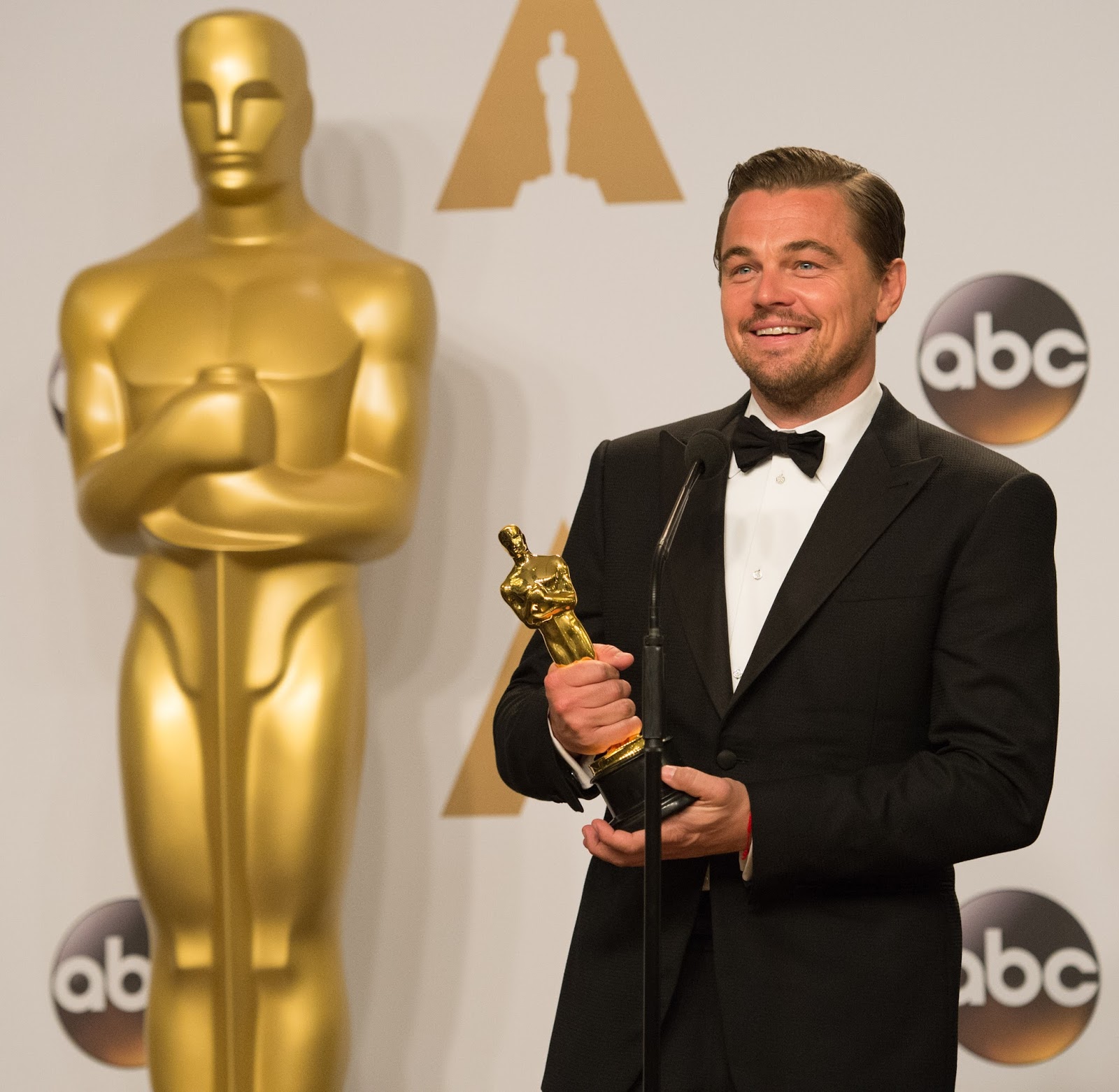
Leonardo DiCaprio, The Revenant
Performance by an Actor in a Leading Role

credit: Michael Yada / ©A.M.P.A.S.
Q. What do you love about being a storyteller?

A. (Leonardo DiCaprio)  Look, I grew up in East Los Angeles.  I was very close to the Hollywood studio system.  But I felt detached from it my whole life.  And to have had parents that have allowed me to be a part of this industry, to take me on auditions every day after school, and to tell stories like this has been my dream ever since I was 4 years old.  And this film to me was exemplary in the sense that I got to work with a director.  And all the things we spoke about off camera during the making of this movie transferred their way on screen.  This was true storytelling.  We really got to have a collaborative experience together, and this was a journey that I'll never forget with Alejandro.  It took up, you know, such a large portion of our lives, but as a result, we have a great film to look back on for years to come.

Q. So I would like to know, where are you going to put that Oscar?  Yeah, a very easy question.  And for you, that second Oscar?

Q. Everyone was cheering in the room here when you won.  How was the atmosphere in the room at the ceremony?  How does it feel now that it's a reality and what would you remember as the biggest challenge of this film?

A. I felt very honored, quite frankly.  This whole thing has been an amazing experience.  And, you know, for me to be able to sit there and not only talk about the film, but to talk about something that I've been duly as obsessed with besides cinema, and that's, you know, our environment and climate change.  To be able to speak about that in a platform of, I don't know, hundreds of millions of people that are watching this, to me, like I said, this is the most existential crisis our civilization has ever known and I wanted to speak out about that tonight because, simultaneously while doing this brilliant film that Alejandro directed, I've been doing a documentary about climate change which has brought me to Greenland, to China, to India to speak with the world's leading experts on this issue.  And the time is now.  It's imperative that we act.  And I really wanted tonight ‑‑ I feel so overwhelmed with, you know, gratitude for what happened tonight.  But I feel there is a ticking clock out there.  There's a sense of urgency that we all must do something proactive about this issue.  And certainly with this upcoming election, the truth is this:  If you have do not believe in climate change, you do not believe in modern science or empirical truths and you will be on the wrong side of history.  And we need to all join together and vote for leaders who care about the future of this civilization and the world as we know it.

Q. It's been such a long time coming, and it seems like the whole world is rooting for you.  The internet, fans, press, there was a WhiteHouse.gov petition to get you an Oscar at one point.  Are you conscious of how many people are supporting you?  How does it feel that people care so much that you get this Oscar?

A. It all feels incredibly surreal.  You know, it's surreal because you can't reach out and physically meet everybody.  You hear it on the internet, you hear it from other people, and, you know, the truth is, we always strive for the best in what we do.  But this year in particular, I've been overwhelmed with such support.  Really, truly, by so many fans and so many people in the industry.  It's quite shocking, actually.  And what can you say except I'm very grateful, I really am.

BACKSTAGE INTERVIEW WITH: 
Mark Rylance, Bridge of Spies
Performance by an Actor in a Supporting Role
credit: Phil McCarten / ©A.M.P.A.S.
Q. I just wanted to know, one, where will you be putting it, and two, you said in your speech you weren't sure how the Academy could separate your performances but tonight you outpunched Rocky and I want to know how that feels and if that's particularly meaningful to you.

A. I don't know where I'll put it yet.  I don't feel I ‑‑ I don't know.  I find people who come up and say things, you know, about competing as actors and I know that it's necessary to make a show out of it, but those actors are so good, I would be happy just to be ‑‑ I feel like more I'm a spokesman when you win than something that's better than the other nominees.  And I know that there's so many wonderful nominees just outside the five of us:  Idris Elba and Paul Dano and all kinds of actors too, so I don't take it too seriously.

Q. When they announced your name, and they were like Mark R... did you think they were going to say Mark Ruffalo?

A. No, but Mark Ruffalo told me on the Red Carpet that that had happened to him at the BAFTAs, that whoever was giving the award had slowed down after the "R" and a number of people on his team, as people call it, had looked around to congratulate him, and then the dreadful y‑l‑a‑n‑c‑e had come forward and crushed his dreams.

Q. Steven Spielberg actually tried twice before to get you in a movie and you, I can't believe this, said no.  What were those films?

A. That was the same film, EMPIRE OF THE SUN, and he offered me a small part.  I think it must have been 1986.  And I turned that down, and then he came back and offered me a better part, and I accepted it, but then a theater director who I very much wanted to work with, had wanted to work with for a number of years, also offered me a part.  And Steven very nicely said I could step away from the film if I wanted to but I had to tell him in four hours, and I did decide after those four hours to step away and do the season of plays.  And though the season of plays didn't go that well, I met my wife on the first day and now I've been able to work with Steven again.  So it turned out to be an all right call.

Q. You've talked about your speech a little bit.  It's being called one of the classiest of the night so far from what I'm seeing.  Did you think about what you would say before you got up there or was it all just in the heat of the moment from your heart?

A. I always think about what I'm going to say, and I choose two or three options.  I had to open Sam Wanamaker's Globe Theatre once and there were seven opening nights, and I had to make a lot of speeches.  And I found that if you over‑prepare a speech, it's like an over‑prepared acting performance.  It's best to have a few different options and a few different endings and beginnings.  I almost dropped the whole thing, actually, after the very funny interviews in Compton because I really longed that I was a black actor at that moment receiving an award.  But I didn't drop it.  No, I make it up partly, but I know the general things I want to say.  I know I wanted to praise Steven and I wanted to praise my fellow nominees and supporting actors generally, because I really enjoy the work of supporting actors when I go to the cinema.  And then there were other things I could have said but I didn't quite get there.  No, I actually said some ‑‑ now I'm remembering.  I think it's best to try and be spontaneous with preparation.

Q. For this film did you shoot on location somewhere interesting?  Did you get to do anything there and enjoy the location where you shot, or locations?

A. We shot on the Glienicke Bridge in Berlin which is where the actual exchange took place, and it was incredibly cold and we had to wear all kinds of things in our shoes and in our gloves and then Chancellor Merkel came along about 2:00 in the morning, with no hat, no scarf, no gloves, and stayed for about 45 minutes talking with everyone, looking at the camera and everything.  She was a little disappointed I didn't speak Russian, she saw through me right away.  But that was very remarkable to make a film of an event that had actually taken place in that space and that's one of the pleasures of working with someone like Spielberg.

BACKSTAGE INTERVIEW WITH: 
Alicia Vikander, The Danish Girl
Performance by an Actress in a Supporting Role

credit: Michael Yada / ©A.M.P.A.S.
Q. Do you feel that your success and the success with THE DANISH GIRL will open the door for additional LGBT stories to be told in Hollywood?

A. I definitely hope so.  I came on this film only two years ago and I know that this was not an easy film to get made and it has been almost 15 years that one of our producers, Gail, had worked on it and to see kind of the cultural change with just me over the years since I actually finished the film with, I don't know, with Caitlyn Jenner coming out, with TRANSPARENT and TANGERINE, it's like a social change and I just wish that ‑‑ in the same way that this film has been so educational for me and with so many people that I got to meet and in preparation for it I hope that it can open up an even wider conversation, if our film can be a part of that discussion.

Q. Can you describe what was your first thought that went through your mind when they announced your name?

A. I'm trying to remember anything that just happened in the last five minutes.  I had my mom next to me which was just ‑‑ I used to every night ‑‑ well, this night every year I woke up and set the alarm clock at 2:00 a.m. to watch this to celebrate in a distance film and people behind films, and to have my mom's hand and to experience being just here in this room has been pretty cool.

Q. Congratulations.  Who will you be celebrating with tonight and what will you be doing to celebrate?

A. I hope I'm going to get the chance to go out, have fun and have a glass of wine and meet up with my family and my entire crew that is here and my friends.  So, and I even have a shorter dress in front so I can bounce and dance in it, so that's what I'm going to do.
bring that out in your clothes, which is fun.

Q. There has been a lot of talk about diversity, obviously at the Oscars and in Hollywood in general.  I was wondering what your take was on Chris Rock tonight in his opening monologue?

A. I thought he was great.  I just admired him.  I admire him as a big comedian, and I'm so happy that he came in tonight and just brought up both a lot of laughs and brought a lot of reality issues in the same way and I'm very happy that he is our host tonight.

Q. What piece of advice would you give to young girls around the world?

A. I don't know.  I actually on stage said to my parents who were there and who have always told me, like, you can actually do it and it has been so many doubts and they are still there and I guess because there's some people who have really ‑‑ [interruption] ‑‑ did I miss something?  Well, what I mean is that apparently a lot of things can be possible, things that I would never, ever, ever have believed in and that is only because I have had some incredible women supporting me so that is probably what I wanted to say to some young girls, just keep on doing it, I guess.

BACKSTAGE INTERVIEW WITH: 
Alejandro G. Iñárritu, The Revenant
Directing

credit: Michael Yada / ©A.M.P.A.S.
Q. What does it mean to win twice in a row?

A. Well, I couldn't be more happy.  Every film is like ‑‑ is like ‑‑ is like a son.  So you cannot like more one son than the other.  I love this film as I loved BIRDMAN, and I think this experience and sharing this with Leo and with all the nominees, part of the crew that we are celebrating tonight.  I think the award that I'm getting is on behalf of all of them and they make possible.  So I couldn't be more happy, especially because we are celebrating tonight, and that's fantastic.

Q. What do you love about being a storyteller?

A. For me, it just basically I think that life is so uncontrollable.  I think we are all the time, you know, it's impermanent, everything.  And I think that storytelling is a way for us to feel, in a way, can confront a huge amount of emotions and possibilities and feel, you know, beautiful and horrible emotions, but always in a way being in a comfortable zone knowing there is another story that can teach us a lot.  So it's a way to control life, you know, to have an oxygen capsule of life without suffering for real, that can teach us for when the time comes, for being in love or do we have a problem, we can suddenly get what is that idea.  So storytelling is, I think, oxygen for life that protect us.  You know, that's how I feel.

Q. How does it feel to be the director who finally did this for Leo?

A. I want to say that it's funny because the conception how a film is being made, I think, is wrong.  This is an intervening collaboration.  You know, everything is connected.  So when Chivo won, we all won.  Because what Chivo photographed was the wardrobe, was the makeup, was the performance of Leo, was the ideas of the original.  When I won, everybody won.  So, I mean, all of the actors, everything.  When Leo ‑‑ so I didn't give nothing to Leo, Leo won by himself.  But we are absolutely interdependent, we depend on the other.  So every award of every film, honestly, it's funny enough, as everything in life is, interconnected and it reflects the effort of hundreds of people.  So that's what is amazing about today, that the awards that we won, it is celebrated by all the team no matter if somebody won or not.  And truly, that's very true, when you work for months with a team like that, you know, that we were basically part of the success of any territory.  We were all involved in anything.

The Big Four
Oscar-winners Rylance, Larson, DiCaprio and Vikander pose backstage with their Oscar for Achievement in acting:
credit: Michael Yada / ©A.M.P.A.S.
Past Oscars Backstage Columns:
20152014 - 2013 - 2012

NOTES ON THE SCORECARD:

Who wore it better...?

Heidi Klum...?
...or Ann Wedgeworth in Steel Magnolias?
Emily Blunt and Charlize Theron backstage (notice the Media Guy with the camera on the left side)...

credit: Monica Almeida/The New York Times
Leo at the engraving station...


Larson after winning the Oscar for best actress...

credit: Monica Almeida/The New York Times
Lady Gaga, barefoot and in a white suit, danced on the balls of her bare feet in the stage right wings as she waited to sing "Til it Happens to You..."


The sexual abuse survivors who had taken the stage behind Lady Gaga screamed, "We love you, Leo!" as he high-fived them. When Larson arrived, the survivors screamed even louder and pumped their fists. "Give us a hug!" they implored the actress, whose film, Room, centered on a sexual abuse survivor. "Yes, yes, yes!" Larson said, rushing into their arms.

After performing, Gaga ran off the stage, down a hallway and around a corner to change her clothes, to be in her seat before the announcement of her category, original song.

These are the droids I was looking for...


He didn't smile much onstage, but backstage Benecio Del Toro was all laughs with Jennifer Garner...


Kerry Washington and Superman Henry Cavill ready themselves for the next awards presentation...


Protest! Apparently a lot of people outside thought that white people suck...


Finally, my top six favorites from the red carpet:

6) Oscar-winner Common greets Olivia Munn...


5) Matt and Whoopi...


4) The allure of Rachel McAdams...


3) The class of Cate Blanchett...


2) A titanic meeting with Leo and Kate...


And my #1 favorite: Jennifer Lawrence...


With that, I'll see you next year on the red carpet with an update from my new agent!